

Asago · Takeda Castle Ruins
Walk the walls above the clouds
Takeda Castle Ruins (竹田城跡) sits on a 353 m summit. Entry is ¥500 for high-school students and older, open 05:00–17:00 until 6 December 2026, then only 10:00–15:00. Two of the four trails are closed after a bear sighting, so plan your route first.
Cover illustration; not a photograph of the actual scenery.
Information checked on 23 October 2026 against the official city pages. · Japanese castle guide
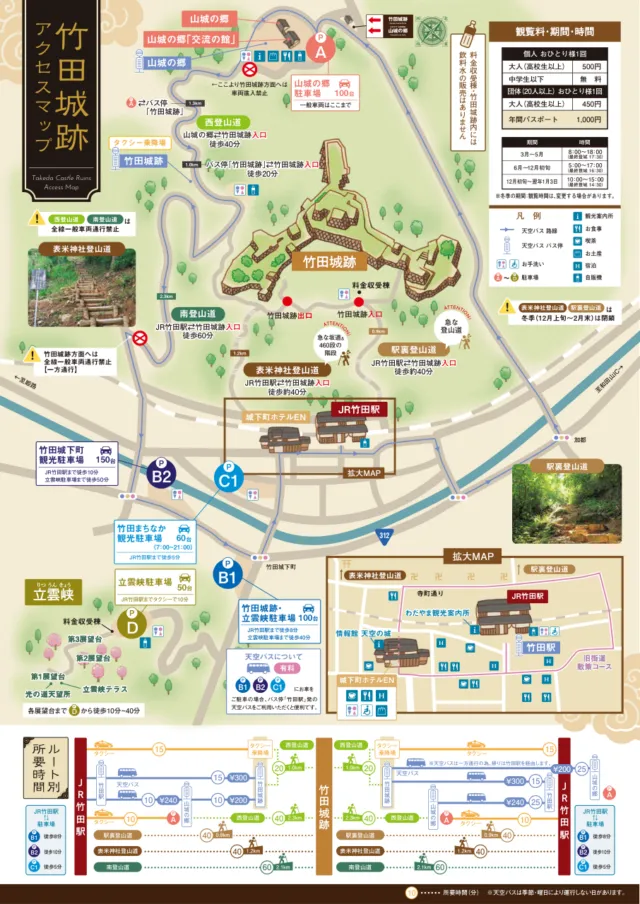
Station-back and Hyomei Shrine trails closed since 16 October. A bear was sighted on the approach, so Asago City closed those two routes “for the time being” (still listed on 23 October). Use the paved west trail from the Yamajo-no-Sato car park (A), or the south trail from car parks B1/B2. From JR Takeda Station, take the Tenku bus. Carry a bell or make noise as you walk. City notice (Japanese)
Walk the ruins or view them?
Takeda Castle has no standing keep: you walk among the stone walls on the summit. For the postcard shot of the castle floating above clouds, you stand on the opposite mountain at Ritsuunkyo instead. They are separate trailheads, so decide before you set the alarm.
Walk inside the walls
Allow 30–60 minutes inside the ruins, plus 40–60 minutes of climbing. Entry is ¥500 at the ticket booth near the top.
See the castle from across the valley
Go to Ritsuunkyo (¥300, separate site). Read the Ritsuunkyo guide.
When can you go in?
| Period | Entry hours |
|---|---|
| 1 Jun – 6 Dec 2026 | 05:00–17:00 |
| 7 Dec – 3 Jan | 10:00–15:00 |
| 4 Jan – end Feb | Closed |
- 1 Jun – 6 Dec 2026: Trail gates: west 04:30–16:30, station-back and Hyomei Shrine 05:00–16:30, south 05:00–16:00. Gates on the way down close at 18:30 (west) or 18:00.
- 7 Dec – 3 Jan: Last gate pass 14:30 (south trail 14:00). No buses in December.
- 4 Jan – end Feb: Winter closure; no entry.
The ruins can close without notice in heavy-rain, flood or storm warnings, typhoons, lightning, snow, frozen trails or emergencies. Asago City: 2026 hours · winter schedule
Fees and payment
| Item | Detail |
|---|---|
| Adult (high school and up) | ¥500 |
| Junior high and younger | Free |
| Group of 20 or more | ¥450 per adult |
- Annual passport, FY2026: ¥1,000; ask on site (no QR payment for this)
- Cards and e-money: Visa, Mastercard, JCB, American Express, Diners Club, DISCOVER, UnionPay; iD, QUICPay, Rakuten Edy, transit IC (not PiTaPa)
- QR payment: PayPay, au PAY, Rakuten Pay, WeChat Pay, UnionPay QR, Alipay, COIN+
- Tenku and Unkai buses: Cash only
Two adults pay ¥1,000 for the ruins. Car parks A, B1 and B2 are free, according to the city. Cashless payment may drop out with a weak signal and no paper ticket is issued, so carry some cash. Fares, taxis, meals and lodging are extra. Asago City: admission
Which trail should you take now?
| Trail | Starts at | Time up | Status |
|---|---|---|---|
| West | Yamajo-no-Sato car park (A) | About 40 min, paved | Open |
| South | Car parks B1 / B2 on Route 312 | About 50–60 min, paved | Open |
| Station-back | Takeda Station area | About 40 min, steep unpaved | Closed (bear) |
| Hyomei Shrine | Takeda Station area | About 40 min, 460 steps | Closed (bear) |
The city quotes 50 minutes in one notice and 60 in another for the south trail; plan on 60. A is the nearest car park; B1 and B2 are 100 and 150 spaces.
Getting there and back
-
By car
From Wadayama IC it is about 10 minutes to the car parks. On October and November weekends the nearest car park (A, 100 cars) can be full by 02:00–03:00. You cannot queue on the road, so go to B1 or B2. Never park on farm roads or private land.
-
By train: JR Takeda Station
Take the JR Bantan Line to Takeda. Because the station-back trail is closed, use the daytime Tenku bus (about 08:00–16:59, not in December). The bus stop is still 900 m, about 20 minutes on foot, from the ticket booth.
-
November weekend dawn: Unkai bus
On weekends and holidays in November only, an early Unkai bus runs from car park B2 and Asago Bridge to Yamajo-no-Sato. From there walk or take a taxi up the west trail. Timetables are on the operator’s site; it carries cash only.
-
Taxi
A taxi can drop you at the mid-slope stop, but the 900 m walk to the booth is for everyone. The visitor desk, 情報館 天空の城, answers at +81-79-674-2120 (09:00–17:00, daily); Japanese support is the confirmed route.
When do clouds appear?
Late autumn has the best odds because of the large temperature swings. In 2026 the early-morning opening runs to Sunday 6 December; from 7 December the ruins open only 10:00–15:00. Clouds are never guaranteed. The city links an unofficial “cloud forecast” on Asabura, which it says does not guarantee results. Weekday mornings are far less crowded than weekends.
What to carry
- A flashlight: there is no lighting on the castle or the trails, and the city calls it essential
- A rain jacket, since the cloud itself can soak you
- Warm layers: it can be below freezing at the top
- Water, ideally warm: none is sold at the summit
- A bell or phone sound to warn wildlife
- Sneakers. No heels or sandals; no tipped canes or umbrellas on the ruins
- No smoking anywhere from car park to castle
Before you go
Check the city notices on the morning you leave, choose the west or south trail, and settle your pickup or parking before dawn. Allow a half day for the ruins alone. If you also want the viewpoint photo, do Ritsuunkyo on a different morning.
Official Takeda Castle notices (Japanese)
Continue planning
- Ritsuunkyo: the viewpoint across the valley
- Hyogo without a car
- Himeji Castle: tickets and access
- Hyogo travel guides